THE GIRL WHO BECAME A BIRD

At length Wai-o-naisa was ordered off upon a secret expedition against the Sioux, and so sudden was his departure that he had no opportunity of bidding farewell to his betrothed. The band of warriors to which he was attached was a long while absent, and one day there came the news that Wai-o-naisa had fallen in a fight with the Menomones.
Ran-che-wai-me was inconsolable, but she dared not show her grief before her parents, and the only relief she could find from her sorrow was to swim over by starlight to the island where she had been accustomed to meet her lover, and there, calling upon his name, bewail the loss of him who was dearer to her than all else.
One night, while she was engaged in this lamentation, the sound of her voice attracted some of her father’s people to the spot. Startled by their appearance the girl tried to climb a tree, in order to hide herself in its branches, but her frame was bowed with sorrow and her weak limbs refused to aid her.
“Wai-o-naisa!” she cried, “Wai-o-naisa!”
At each repetition of his name her voice became shriller, while, as she endeavoured to screen herself in the underwood, a soft plumage began to cover her delicate limbs, which were wounded by the briers. She tossed her arms to the sky in her distress and they became clothed with feathers. At length, when her pursuers were close upon her, a bird arose from the bush they had surrounded, and flitting from tree to tree, it fled before them, ever crying:
“Wai-o-naisa!”
“Wai-o-naisa!”
THE JOURNEY TO THE ISLAND OF SOULS

No one was like the brave Outalissa in her eyes: his deeds were the greatest, his skill was the most wonderful. It was not permitted them, however, to become the inhabitants of one lodge. Death came to the flower of the Chippeways.
In the morning of her days she died, and her body was laid in the dust with the customary rites of burial. All mourned for her, but Outalissa was a changed man. No more did he find delight in the chase or on the war- path. He grew sad, shunned the society of his brethren. He stood motionless as a tree in the hour of calm, as the wave that is frozen up by the breath of the cold wind.
Joy came no more to him. He told his discontent in the ears of his people, and spoke of his determination to seek his beloved maiden. She had but removed, he said, as the birds fly away at the approach of winter, and it required but due diligence on his part to find her. Having prepared himself, as a hunter makes ready for a long journey, he armed himself with his war-spear and bow and arrow, and set out to the Land of Souls.
Directed by the old tradition of his fathers, he travelled south to reach that region, leaving behind him the great star. As he moved onwards, he found a more pleasant region succeeding to that in which he had lived.
Daily, hourly, he remarked the change. The ice grew thinner, the air warmer, the trees taller. Birds, such as he had never seen before, sang in the bushes, and fowl of many kinds were pluming themselves in the warm sun on the shores of the lake. The gay woodpecker was tapping the hollow beech, the swallow and the martin were skimming along the level of the green vales.
He heard no more the cracking of branches beneath the weight of icicles and snow, he saw no more the spirits of departed men dancing wild dances on the skirts of the northern clouds, and the farther he travelled the milder grew the skies, the longer was the period of the sun’s stay upon the earth, and the softer, though less brilliant, the light of the moon.
Noting these changes as he went with a joyful heart, for they were indications of his near approach to the land of joy and delight, he came at length to a cabin situated on the brow of a steep hill in the middle of a narrow road.
At the door of this cabin stood a man of a most ancient and venerable appearance. He was bent nearly double with age. His locks were white as snow. His eyes were sunk very far into his head, and the flesh was wasted from his bones, till they were like trees from which the bark has been peeled. He was clothed in a robe of white goat’s skin, and a long staff supported his tottering limbs whithersoever he walked.
The Chippeway began to tell him who he was, and why he had come thither, but the aged man stopped him, telling him he knew upon what errand he was bent.
“A short while before,” said he, “there passed the soul of a tender and lovely maiden, well-known to the son of the Red Elk, on her way to the beautiful island. She was fatigued with her long journey, and rested a while in this cabin. She told me the story of your love, and was persuaded that you would attempt to follow her to the Lake of Spirits.”
The old man, further, told Outalissa that if he made speed he might hope to overtake the maiden on the way. Before, however, he resumed his journey he must leave behind him his body, his spear, bow, and arrows, which the old man promised to keep for him should he return.
The Chippeway left his body and arms behind him, and under the direction of the old man entered upon the road to the Blissful Island. He had travelled but a couple of bowshots when it met his view, even more beautiful than his fathers had painted it.
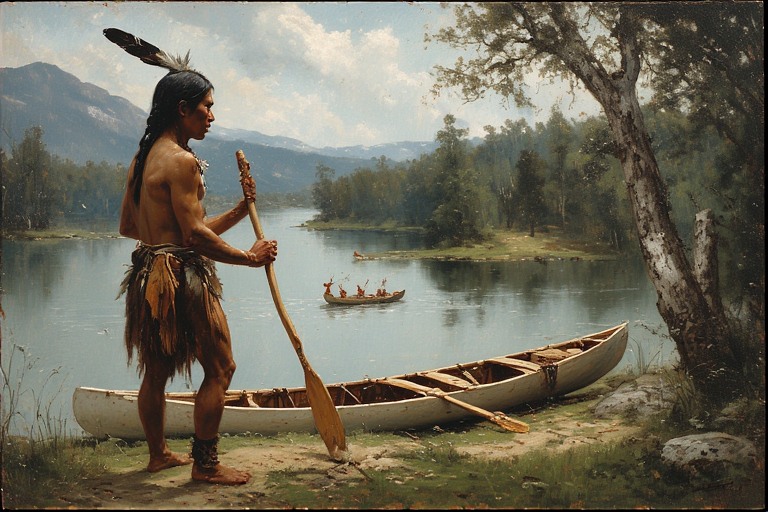 He stood upon the brow of a hill which sloped gently down to the water
of a lake which stretched as far as eye could see. Upon its banks were
groves of beautiful trees of all kinds, and many canoes were to be seen
gliding over its water.
He stood upon the brow of a hill which sloped gently down to the water
of a lake which stretched as far as eye could see. Upon its banks were
groves of beautiful trees of all kinds, and many canoes were to be seen
gliding over its water.
Afar, in the centre of the lake, lay the beautiful island appointed for the residence of the good. He walked down to the shore and entered a canoe which stood ready for him, made of a shining white stone. Seizing the paddle, he pushed off from the shore and commenced to make his way to the island. As he did so, he came to a canoe like his own, in which he found her whom he was in pursuit of. She recognised him, and the two canoes glided side by side over the water.
Then Outalissa knew that he was on the Water of Judgment, the great water over which every soul must pass to reach the beautiful island, or in which it must sink to meet the punishment of the wicked.
The two lovers glided on in fear, for the water seemed at times ready to swallow them, and around them they could see many canoes, which held those whose lives had been wicked, going down. The Master of Life had, however, decreed that they should pass in safety, and they reached the shores of the beautiful island, on which they landed full of joy.
It is impossible to tell the delights with which they found it filled. Mild and soft winds, clear and sweet waters, cool and refreshing shades, perpetual verdure, inexhaustible fertility, met them on all sides. Gladly would the son of the Red Elk have remained for ever with his beloved in the happy island, but the words of the Master of Life came to him in the pauses of the breeze, saying
“Go back to thy own land, hunter. Your time has not yet come. You have not yet performed the work I have for you to do, nor can you yet enjoy those pleasures which belong to them who have performed their allotted task on earth. Go back, then. In time thou shalt rejoin her, the love of whom has brought thee hither.”
THE BOY WHO SNARED THE SUN

“I will leave you behind where I have been chopping; you must hide yourself, and you will see the gitshee-gitshee-gaun ai see-ug, or snow-birds, come and pick the worms out of the wood, where I have been chopping. Shoot one of them and bring it home.”
He obeyed her, and tried his best to kill one, but came home unsuccessful. She told him he must not despair, but try again the next day. She accordingly left him at the place where she got wood and returned home. Towards nightfall she heard his footsteps on the snow, and he came in exultingly, and threw down one of the birds he had killed.
“My sister,” said he, “I wish you to skin it and stretch the skin, and when I have killed more I will have a coat made out of them.”
“What shall we do with the body?” asked she, for as yet men had not begun to eat animal food, but lived on vegetables alone.
“Cut it in two,” he answered, “and season our pottage with one-half of it at a time.”
She did so. The boy continued his efforts, and succeeded in killing ten birds, out of the skins of which his sister made him a little coat.
“Sister,” said he one day, “are we all alone in the world? Is there nobody else living?”
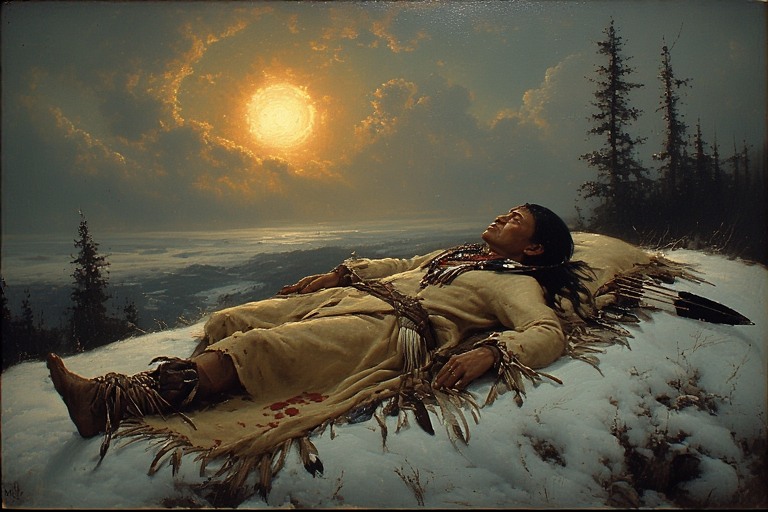 His sister told him that they two alone remained; that the beings who had
killed all their relations lived in a certain quarter, and that he must by no
means go in that direction. This only served to inflame his curiosity and
raise his ambition, and he soon after took his bow and arrows and went to
seek the beings of whom his sister had told him.
His sister told him that they two alone remained; that the beings who had
killed all their relations lived in a certain quarter, and that he must by no
means go in that direction. This only served to inflame his curiosity and
raise his ambition, and he soon after took his bow and arrows and went to
seek the beings of whom his sister had told him.
After walking a long time and meeting nothing he became tired, and lay down on a knoll where the sun had melted the snow. He fell fast asleep, and while sleeping the sun beat so hot upon him that it singed and drew up his birdskin coat, so that when he awoke and stretched himself, he felt, as it were, bound in it. He looked down and saw the damage done, and then he flew into a passion, upbraided the sun, and vowed vengeance against it.
“Do not think you are too high,” said he; “I shall revenge myself.”
On coming home he related his disaster to his sister, and lamented bitterly the spoiling of his coat. He would not eat. He lay down as one that fasts, and did not stir or move his position for ten days, though his sister did all she could to arouse him. At the end of ten days he turned over, and then lay ten days on the other side. Then he got up and told his sister to make him a snare, for he meant to catch the sun.
At first she said she had nothing, but finally she remembered a little piece of dried deer’s sinew that her father had left, and this she soon made into a string suitable for a noose. The moment, however, she showed it to her brother, he told her it would not do, and bade her get something else. She said she had nothing at all.
At last she thought of her hair, and pulling some of it out made a string. Her brother again said it would not answer, and bade her, pettishly, and with authority, make him a noose. She replied that there was nothing to make it of, and went out of the lodge. When she was all alone she said:
“Neow obewy indapin.”
Meanwhile her brother awaited her, and it was not long before she reappeared with some tiny cord. The moment he saw it he was delighted.
“This will do,” he cried, and he put the cord to his mouth and began pulling it through his lips, and as fast as he drew it changed to a red metal cord of prodigious length, which he wound around his body and shoulders. He then prepared himself, and set out a little after midnight that he might catch the sun before it rose.
He fixed his snare on a spot just where he thought the sun would appear; and sure enough he caught it, so that it was held fast in the cord and could not rise.
The animals who ruled the earth were immediately put into a great commotion. They had no light. They called a council to debate the matter, and to appoint some one to go and cut the cord, a very hazardous enterprise, for who dare go so near to the sun as would be necessary? The dormouse, however, undertook the task.
At that time the dormouse was the largest animal in the world; when it stood up it looked like a mountain. It set out upon its mission, and, when it got to the place where the sun lay snared, its back began to smoke and burn, so intense was the heat, and the top of its carcass was reduced to enormous heaps of ashes.
It succeeded, however, in cutting the cord with its teeth and freed the sun, but was reduced to a very small size, and has remained so ever since. Men call it the Kug-e-been-gwa-kwa.
THE DISCOVERY OF THE UPPER WORLD

At that time few of the Indian tribes wore the human form. Some had the figures or semblances of beasts. The Paukunnawkuts were rabbits, some of the Delawares were ground-hogs, others tortoises, and the Tuscaroras, and a great many others, were rattlesnakes. The Sioux were the hissing-snakes, but the Minnatarees were always men. Their part of the great cavern was situated far towards the mountains of snow.
The great cavern in which the Indians dwelt was indeed a dark and dismal region. In the country of the Minnatarees it was lighted up only by the rays of the sun which strayed through the fissures of the rock and the crevices in the roof of the cavern, while in that of the Mengwe all was dark and sunless.
The life of the Indians was a life of misery compared with that they now enjoy, and it was endured only because they were ignorant of a fairer or richer world, or a better or happier state of being.
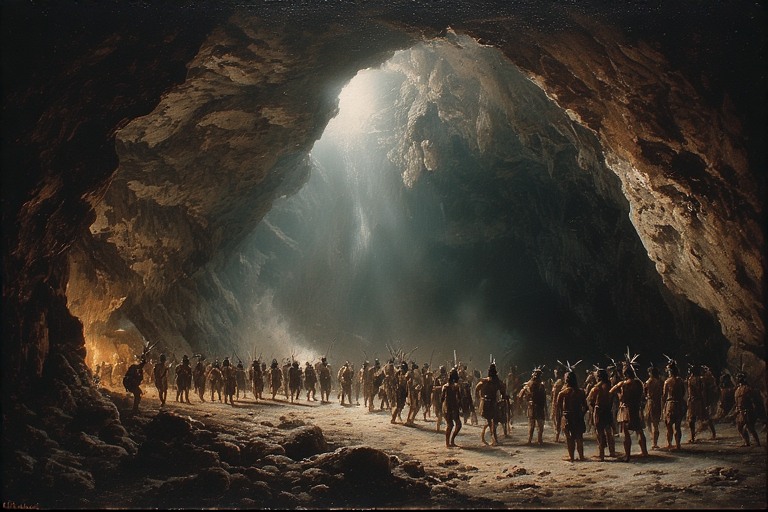 There were among the Minnatarees two boys, who, from the hour of their
birth, showed superior wisdom, sagacity, and cunning. Even while they
were children they were wiser than their fathers.
There were among the Minnatarees two boys, who, from the hour of their
birth, showed superior wisdom, sagacity, and cunning. Even while they
were children they were wiser than their fathers.
They asked their parents whence the light came which streamed through the fissures of the rock and played along the sides of the cavern, and whence and from what descended the roots of the great vine. Their father could not tell them, and their mother only laughed at the question, which appeared to her very foolish.
They asked the priest, but he could not tell them; but he said he supposed the light came from the eyes of some great wolf. The boys asked the king tortoise, who sulkily drew his head into his shell, and made no answer.
When they asked the chief rattlesnake, he answered that he knew, and would tell them all about it if they would promise to make peace with his tribe, and on no account kill one of his descendants.
The boys promised, and the chief rattlesnake then told them that there was a world above them, a beautiful world, peopled by creatures in the shape of beasts, having a pure atmosphere and a soft sky, sweet fruits and mellow water, well-stocked hunting-grounds and well-filled lakes.
He told them to ascend by the roots, which were those of a great grape-vine. A while after the boys were missing; nor did they come back till the Minnatarees had celebrated their death, and the lying priest had, as he falsely said, in a vision seen them inhabitants of the land of spirits.
The Indians were surprised by the return of the boys. They came back singing and dancing, and were grown so much, and looked so different from what they did when they left the cavern, that their father and mother scarcely knew them.
They were sleek and fat, and when they walked it was with so strong a step that the hollow space rang with the sound of their feet. They were covered with the skins of animals, and had blankets of the skins of racoons and beavers. They described to the Indians the pleasures of the upper world, and the people were delighted with their story.
At length they resolved to leave their dull residence underground for the upper regions. All agreed to this except the ground-hog, the badger, and the mole, who said, as they had been put where they were, they would live and die there. The rabbit said he would live sometimes above and sometimes below.
When the Indians had determined to leave their habitations underground, the Minnatarees began, men, women, and children, to clamber up the vine, and one-half of them had already reached the surface of the earth, when a dire mishap involved the remainder in a still more desolate captivity within its bowels.
There was among them a very fat old woman, who was heavier than any six of her nation. Nothing would do but she must go up before some of her neighbours. Away she clambered, but her weight was so great that the vine broke with it, and the opening, to which it afforded the sole means of ascending, closed upon her and the rest of her nation.